Where therapy feels like play.
“I think it’s absolutely essential for his wellbeing.”
Why families and therapists choose this trampoline
Families and therapists choose Mr Trampoline equipment for its stable, responsive bounce and adaptable design. The right size and setup can support movement confidence, coordination, balance, regulation and active play while keeping practice engaging and fun. Evidence and funding resources are available to help with planning and a well-informed purchase.
Daily living
Motor planning, balance and coordination practised in short, repeatable sessions. Therapists often use the bounce to work on transfers, sitting balance and body awareness that carry over to everyday tasks.
Health & wellbeing
Low-impact cardiovascular exercise, muscle tone and endurance. Movement that is genuinely fun tends to happen more often — which is rather the point.
Social & community participation
A backyard trampoline is a place siblings, friends and neighbours already want to be. Turn-taking, shared games and joining in happen naturally around it.
Relationships
Shared play builds connection. Many families tell us the trampoline is where conversation and laughter come easiest — no goals sheet required.
Lifelong learning
Following instructions, sequencing movements, counting bounces, waiting for a turn: the mat doubles as a place to practise skills that show up in the classroom.
Choice & control
Confidence in movement builds independence. A safe, level-access setup lets participants choose how, when and for how long they move — on their own terms.
Facts your therapist will want
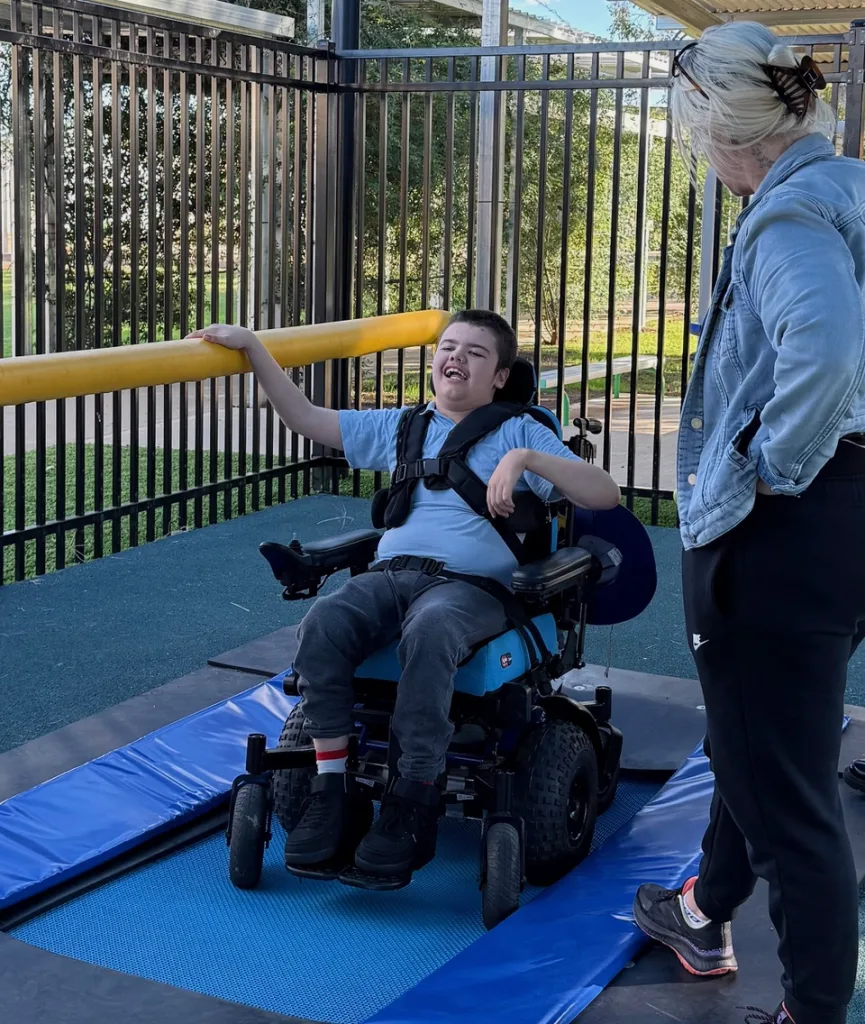
- In-ground installation means no fall height — the bed sits flush with the lawn.
- Level access on and off the mat — in-ground and in-deck installs suit wheelchair transfer.
- Soft, deep bounce from up to 114 galvanised 11-inch springs, tested to 1000kg.
- 30-year frame & structural warranty.
- 8-year bed warranty with scheduled re-coating; 5-year warranty on rubber surrounds.
- Every part is replaceable, forever — the equipment outlasts the plan.
What the research does — and doesn't — say
Certainty matters more than enthusiasm. This is our plain reading of the published research — the same summary we include in the Evidence Pack.
Balance — moderate-to-low certainty
A 2026 meta-analysis in Frontiers pooling 15 randomised controlled trials found trampoline-based training improved balance outcomes. The authors rated the certainty of that evidence moderate to low — encouraging, not conclusive.
Autism — motor skills
Small controlled studies report gains in gross motor skills and coordination for autistic children. Results are promising, but the studies are small and more research is needed.
Cerebral palsy
Early studies suggest improvements in balance and gross motor function for children with cerebral palsy. The evidence base is small and further trials are needed before firm claims can be made.
Parkinson's disease — adults
Preliminary research in adults shows potential balance and confidence benefits. It is not yet strong enough to be called established.
Rebound therapy — where it began
Rebound therapy is the therapist-led use of trampolines, pioneered in the UK by Eddy Anderson in 1969. It has been used in special-education and therapy settings for more than fifty years, with structured programs working on muscle tone, balance reactions, spatial awareness and communication — always graded to the participant by a trained therapist.
Sensory regulation — practice-based
Therapists widely report that rhythmic bouncing provides strong proprioceptive and vestibular input, which some participants find organising and calming. This use is well established in day-to-day practice, though the published evidence base remains small — we would rather tell you that than oversell it.
What we will not claim: that a trampoline treats or cures any condition, that it substitutes for therapy, that funding is likely, or that the research is stronger than it is. Your therapist is the right person to judge fit — our job is to build the safest, longest-lasting trampoline they could put their name to.
Worth knowing: the 2024 change affects equipment purchases, not therapy. Rebound-therapy sessions delivered by your therapist remain fundable under your existing therapy supports, exactly as before.
How a replacement-support application works
Five steps, in order. The one that matters most is step four.
Talk to your therapist
It starts with your occupational therapist, physiotherapist or exercise physiologist. They assess whether trampoline-based therapy — often called rebound therapy — addresses goals already in your NDIS plan.
Gather the evidence
Your therapist writes a letter linking the trampoline to your plan goals. We supply a formal quote and our Evidence Pack — equipment specifications, safety data and a plain summary of the published research — to attach.
Apply to the NDIA
You, your plan manager or your support coordinator submit a replacement-support application to the NDIA with the therapist letter, quote and evidence attached.
Wait for written approval
Do not purchase before you have the NDIA’s written approval. Money spent before approval generally cannot be claimed back — no matter how strong the application was.
Purchase and install
With approval in writing, order with confidence. We deliver Australia-wide and can usually help you find an installer nationally if you prefer not to DIY. We manufacture residential trampolines and can provide drawings to support your builder or installer.
“Our students absolutely love the trampolines from Mr Trampoline — they use them every single day. The quality is outstanding, and they are wonderfully bouncy, bringing so much joy and movement into playtime.”
What your plan management means
The straight answer first: since October 2024, the NDIS generally cannot fund trampolines. There is one narrow pathway — a replacement support application — and it requires written NDIA approval before you purchase. Everything on this page exists to help you and your therapist decide whether that pathway genuinely fits, and to make the application as strong and as honest as it can be.
Plan-managed
Your plan manager pays our invoice directly once the NDIA has approved the replacement support. We’re happy to talk to your plan manager at any point.
Self-managed
You pay us and claim reimbursement against the approved replacement support. Keep the written approval, invoice and receipts together.
NDIA-managed (agency)
We are not a registered NDIS provider, so NDIA-managed participants cannot purchase from us. We’d rather tell you that plainly now than after you’ve fallen in love with a trampoline.
Where we stand: we will never help dress a purchase up as something it isn’t. If a replacement-support application doesn’t genuinely fit your circumstances, we’ll say so — and you’ll still be welcome to buy from us the ordinary way, like thousands of families do.
Asked every week
Can I just buy it and claim later?
No. Reimbursement without prior written approval is generally refused. Approval first, purchase second — always.
Are you a registered NDIS provider?
No, and we’re upfront about it: NDIA-managed participants can’t purchase from us. Plan-managed and self-managed participants can, once a replacement support has been approved in writing.
Will you talk to my therapist or plan manager?
Gladly. We’ll supply specifications, the Evidence Pack and a formal quote, and we’re happy to answer their questions directly.
What should the therapist letter cover?
How trampoline-based activity addresses goals already in the plan, why it’s the appropriate option compared with alternatives, and how it will be used safely. Our Evidence Pack includes a checklist.
Does it need to be a particular trampoline?
The NDIA assesses your application, not our catalogue. Most therapy applications we see involve in-ground installation, for level access and no fall height.
This page is general information, not advice about your individual plan. NDIS rules change — always confirm current requirements with the NDIA or your plan manager. Information last verified 13 July 2026.
Choose your trampoline size and get a quote
Choose from four sizes and request a quote for the setup that suits your space. Need help planning? Our Evidence Pack is available as a secondary resource for your therapist or funding application.
The public version of the pack is here: NDIS evidence pack.
Helpful guides: FAQ · Compare sizes